
Fifth Article — Fine-Tuning
Introduction
Hook:
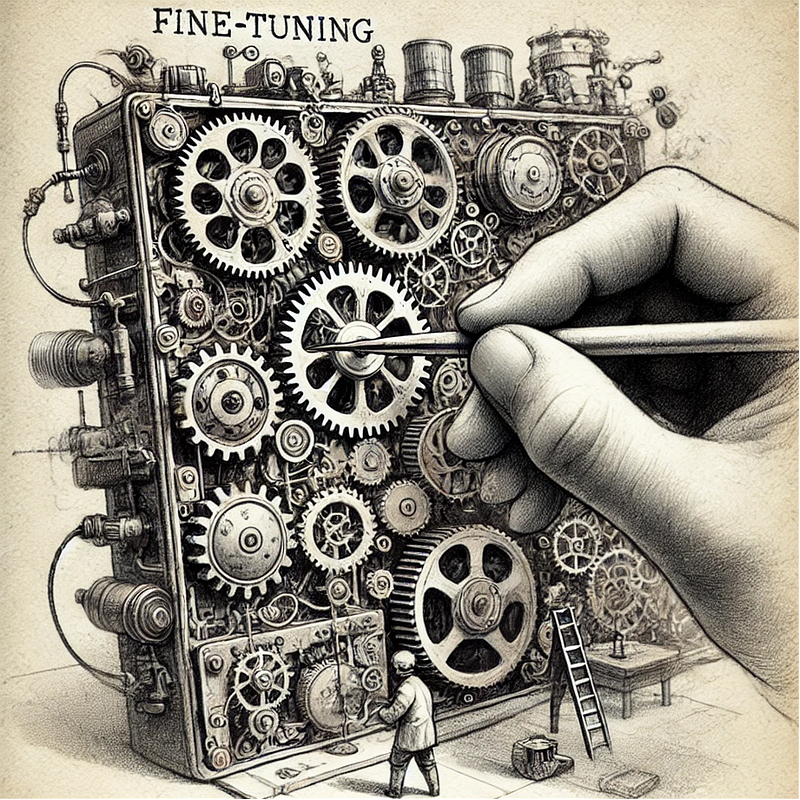
Picture buying a Swiss Army knife and customizing one of its blades into a professional corkscrew — ready to tackle wine bottles at a moment's notice. That's fine-tuning in a nutshell: taking a general-purpose AI model (like GPT-4 or BERT) and tailoring it for your unique tasks — be it medical diagnostics, legal contract analysis, or social media content creation.
Why This Matters:
Pre-trained models are jacks-of-all-trades. Fine-tuning transforms them into domain specialists:
- More Accurate Results — A GPT-3.5 chatbot becomes better at medical Q&A when trained on clinical data.
- Faster Deployment — No need to build an AI from scratch; tap into existing power and adapt.
- Cost-Effective — Leverage massive, pre-trained AI with minimal resource overhead.
In an era of Agentic AI, BOTS, Digital transformation, banks need AI that goes beyond basic text generation. Pre-trained models (like GPT-4 or BERT) are powerful but broad. Fine-tuning them with banking datasets ensures:
- Greater Accuracy in tasks like loan underwriting or risk scoring.
- Faster Time-to-Market for AI-driven products — no need to build models from scratch.
- Cost Efficiency — leverage existing AI investments rather than running massive training jobs.
What Is Fine-Tuning?
Simple Definition:
Fine-tuning is the process of adapting a pre-trained AI model to perform specialized tasks by training it further on a smaller, domain-specific dataset.
Analogy:
Think of it like hiring a multilingual tour guide (the pre-trained model) and teaching them the slang of your hometown (your data). Now they're not just fluent — they're local experts.
Key Components
We focus on three main pillars:
- Model Adaptation: Adjust the model's layers and weights to prioritize your task (e.g., legal contract analysis).
- Dataset Preparation: Collect, clean, and label high-quality examples that reflect your domain.
- Domain Specialization: Steer outputs toward banking use cases like fraud detection or risk modeling.
How It Works
Step 1: Choose a Base Model
- GPT-3.5 or GPT-4 or Deepseek → Great for text generation tasks (e.g., drafting customer correspondence, summarizing loan documents).
- BERT / DistilBERT → Excellent for classification tasks (e.g., predicting credit risk, classifying transaction types).
- FinBERT or Financial Transformers → Already specialized in financial language, requiring fewer domain adjustments.
Rule of Thumb: Start with an architecture that aligns best with your use cases and objective — whether it's text classification or advanced language generation.
Step 2: Prepare Your Dataset
- Data Collection:
Loan Applications: With labels like approved, pending, or rejected.
Transaction Logs: Annotated for fraudulent vs. legitimate.
Customer Chat Logs: Mark sentiments as positive, neutral, or negative. - Cleaning & Labeling:
Remove personally identifiable information (PII) for compliance.
Ensure consistent labeling standards (e.g., "fraud" vs. "possible fraud").
Example CSV for Sentiment Analysis of Customer Support Chats:
text, label
"I love how quickly my issue was resolved!", positive
"Your fees are too high and customer service was unhelpful!", negative
Pro Tip: If your banking datasets are small, use data augmentation (e.g., paraphrasing dialogues, adding synonyms) while maintaining confidentiality and compliance.
Step 3: Modify the Model
- Freeze early layers (retain general knowledge).
- Retrain later layers on your data:
from transformers import Trainer, TrainingArguments

training_args = TrainingArguments(
  output_dir="./results",
  num_train_epochs=3,
  per_device_train_batch_size=16,
  evaluation_strategy="epoch"
)

trainer = Trainer(
  model=model,
  args=training_args,
  train_dataset=train_dataset,
  eval_dataset=val_dataset
)

trainer.train()
Key Parameters: Adjust epochs and learning rate based on validation performance. Stop early to avoid overfitting to niche banking data.
Step 4: Evaluate and Iterate
- Validation Set: Use a held-out subset of data (e.g., loan applications from different branches or times of year).
- Metrics: For approval classification, measure accuracy, precision, recall, or ROC-AUC to evaluate model reliability.
Example: If the model incorrectly flags a significant number of legitimate loan applications as high-risk, you may need to adjust class weights or data balance.
Real-World Applications
- Healthcare: Fine-tune BioBERT to extract cancer stages from medical notes.
- E-Commerce: Train CLIP to tag products with "summer vibes" or "office chic."
- Financial Document Summarization: Condense compliance documents (Basel III, Dodd-Frank) into key highlights to save analysts hours.
- Robo-Advisory Services: Tailor a language model to recommend financial products based on customer profiles and risk tolerance.
Challenges & Best Practices
Pitfalls
Overfitting: If your dataset is small or overly specialized, the model may fail to generalize.
Compliance & Data Privacy: In banking, data must be anonymized and securely stored.
Data Scarcity: Fine-tuning a legal model? 100 examples won't cut it — aim for 10,000+.
Pro Tips
- Start with a Financial Transformer: Models like FinBERT already know financial language and reduce domain gaps.
- Layer Freezing: Preserve broad linguistic knowledge by freezing early layers and fine-tuning later ones.
- Bias Monitoring: Ensure your training data represents all customer segments to avoid discriminatory AI decisions.
Tools & Resources
- Hugging Face: Hub for pre-trained models and fine-tuning scripts.
- TensorFlow Hub / PyTorch Lightning: Frameworks that simplify model adaptation.
- Weights & Biases: Track training metrics and hyperparameters.
Conclusion
Fine-tuning is the bridge between generic AI and your unique needs. With the right data and tools, you can turn a jack-of-all-trades model into a specialist — no PhD required. The financial sector stands to gain unmatched efficiency and customer satisfaction through specialized, fine-tuned models — without reinventing the AI wheel.
Next Up:
"Keeping AI Safe, Fair, and Clean" (Article 6). Learn how content filtering protects users from harmful outputs!
Call-to-Action
Have you fine-tuned a model for a quirky or critical task? Share your wins (or disasters!) in the comments — let's geek out together.