
Agentic AI for Banking
In today's rapidly changing world, Artificial Intelligence including GenAI is transforming how financial services work. Yet many professionals in the industry find themselves trying to understand these changes without technical expertise, often struggling to separate genuine innovation from marketing hype.
This seven-part series breaks down Agentic AI into clear, understandable concepts. Written in plain language for anyone working in financial services, each article provides straightforward explanations, real-world examples, and practical insights that apply to institutions of all sizes.
We'll explore how AI agents are reshaping everything from customer interactions and security to personalized services and behind-the-scenes operations — with special attention to opportunities in the Middle East's evolving financial landscape.
Join us as we move beyond technical jargon to provide you with the understanding needed to confidently participate in this transformation, regardless of your technical background.
In This Series:
- What Are AI Agents and Why Should Bankers Care?
- Customer Service Transformed: AI Agents as Digital Banking Concierges
- Fraud Detection and Risk Management: AI Agents as Vigilant Guardians
- Personalized Banking: How AI Agents Can Tailor Services to Individual Needs
- Back-Office Efficiency: AI Agents Streamlining Banking Operations
- Implementation Journey: Bringing AI Agents into Your Bank
- The Future of Banking with AI Agents: Opportunities and Challenges
Article 1: What Are AI Agents and Why Should Bankers Care?
Article 1 in a 7-part series on Agentic AI for Banking
Introduction
Imagine walking into your bank branch and being greeted by a team of specialized assistants: one expert in mortgage options, another in investment strategies, a third in fraud prevention, and a fourth in customer service — all working in perfect coordination, available 24/7, and continuously learning from every interaction to serve you better. This isn't science fiction; it's the promise of AI agents in banking.
While technology buzzwords come and go, AI agents represent a fundamental shift in how financial institutions can operate and serve their customers. But what exactly are AI agents, and why should banking professionals who may not have technical backgrounds pay attention? This article breaks down agentic AI in simple terms and explores why it matters for the future of banking.
What Exactly Are AI Agents?
Beyond Simple Automation
Traditional banking automation has focused on completing specific, repetitive tasks: automatic payments, ATM transactions, or basic chatbots that follow rigid scripts. These tools certainly improve efficiency but are limited by their narrow focus.
AI agents take a significant leap forward. Rather than just executing predefined tasks, they:
- Make decisions based on their understanding of banking goals and constraints
- Learn from experience to continuously improve their performance
- Coordinate with other systems to complete complex banking workflows
- Adapt to new situations without requiring reprogramming
Think of traditional AI like a calculator — useful but limited to what it was explicitly programmed to do. AI agents are more like knowledgeable colleagues who understand banking objectives and can figure out how to achieve them, even as conditions change.
Real-World Banking Example
When a customer applies for a mortgage, traditional automation might simply collect information and pass it to a human underwriter. An AI agent system, however, could:
- Gather application information through natural conversation
- Pull relevant data from multiple systems (credit scores, property values, etc.)
- Analyze the customer's financial situation against current lending criteria
- Generate preliminary approval recommendations
- Identify potential issues and suggest solutions
- Prepare a comprehensive package for final human review
- Keep the customer updated throughout the process
All of this happens while adhering to compliance requirements and bank policies — and without requiring human intervention for routine cases.
Why Banking Is Prime Territory for AI Agents
The banking industry faces unique challenges that make it especially suitable for agentic AI solutions:
1. Data-Rich Environment
Banks possess vast amounts of structured data: transaction histories, account balances, loan performance, and customer profiles. This data-rich environment provides the foundation AI agents need to make informed decisions and recommendations.
2. Process-Driven Operations
Banking operations typically follow well-defined processes with clear rules and regulations. This structure makes it easier to deploy AI agents that can understand and navigate these established workflows, bringing efficiency while maintaining compliance.
3. High-Volume, Repetitive Tasks
Many banking functions involve high-volume, repetitive tasks that require accuracy and consistency — from transaction processing to regulatory reporting. AI agents excel at handling these activities tirelessly while freeing human talent for more complex work.
4. Need for Personalization at Scale
Today's customers expect personalized service, but delivering this at scale is challenging with human resources alone. AI agents can analyze individual customer data and provide tailored recommendations and services to thousands of customers simultaneously.
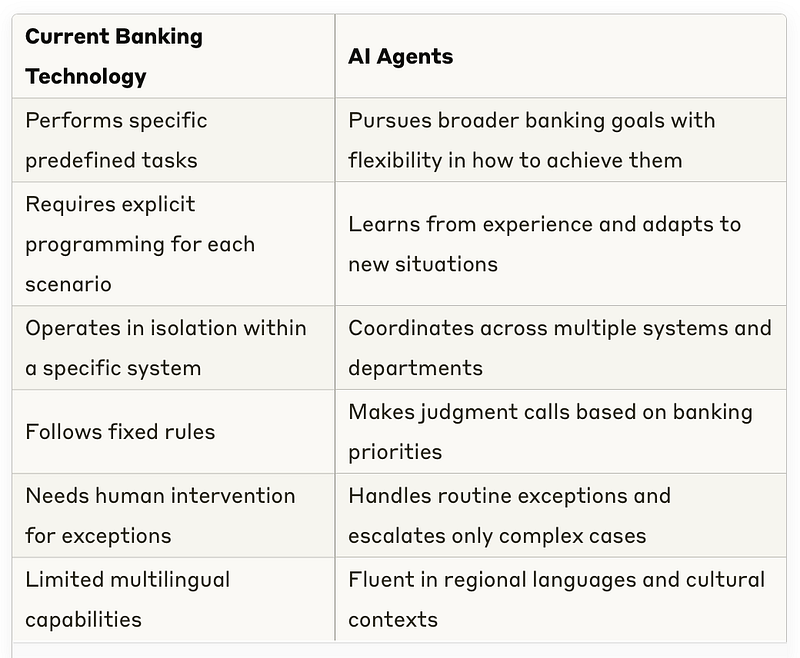
How AI Agents Differ from Current Banking Technology
To appreciate the significance of AI agents, it helps to understand how they differ from technologies already in use:
Five Ways AI Agents Will Transform Banking
1. Enhanced Customer Experience
AI agents can provide consistent, personalized service across all channels — from branch visits to mobile banking. They remember customer preferences, anticipate needs based on life events, and offer relevant solutions without the customer having to navigate complex bank structures.
2. Operational Efficiency
By handling routine transactions, customer inquiries, and back-office processes, AI agents allow banks to serve more customers with fewer resources. This efficiency translates to competitive advantages in pricing and service quality.
3. Risk Management and Compliance
Banking regulations continue to grow in complexity. AI agents can monitor transactions in real-time for suspicious patterns, maintain comprehensive audit trails, and help ensure compliance with evolving regulations — tasks that would require enormous human resources.
4. Product Innovation
By analyzing customer data and market trends, AI agents can identify unmet needs and help banks develop new products and services. They can also facilitate rapid testing and refinement of these offerings based on customer response.
5. Employee Empowerment
Rather than replacing banking professionals, AI agents serve as powerful tools that enhance human capabilities. They handle routine matters, provide relevant information at crucial moments, and free bankers to focus on relationship building and complex decision-making.
Starting Your Bank's AI Agent Journey
While full implementation of AI agent systems requires thoughtful planning, banks of all sizes can begin the journey today:
- Identify pain points in your current operations where AI agents could provide immediate value
- Start with focused applications rather than attempting comprehensive transformation
- Prioritize customer experience opportunities that directly impact satisfaction and loyalty
- Prepare your data foundation by ensuring information is accessible and well-structured
- Include non-technical teams in planning to ensure solutions address real banking needs
Conclusion
AI agents represent more than just another technology upgrade for banks — they offer a fundamental shift in how financial institutions can operate and serve customers. For banking professionals without technical backgrounds, understanding the potential of AI agents doesn't require deep knowledge of the underlying technology. Instead, focus on the capabilities they bring: intelligent automation, personalized service at scale, continuous improvement, and powerful support for human banking professionals.
As we explore specific applications in the coming articles in this series, we'll see how AI agents are already transforming customer service, fraud detection, personalized banking, back-office operations, and strategic planning. The banks that thrive in the coming decade will be those that successfully integrate these powerful tools while maintaining their human touch and customer trust.
Coming Up Next in Our AI Agent Banking Series
In our next article, "Customer Service Transformed: AI Agents as Digital Banking Concierges," we'll take a deep dive into how AI agents are revolutionizing the front lines of banking. You'll discover:
- How leading banks are deploying AI agents to handle routine customer inquiries with unprecedented accuracy and personalization
- Real-world examples of AI concierges that seamlessly support customers across web, mobile, and in-branch experiences
- The surprising ways AI agents are reducing wait times while actually increasing customer satisfaction scores
- Practical implementation strategies that banks of all sizes can adopt without massive technology overhauls
This article is part 1 of our 7-part series "Agentic AI for Banking." Follow along weekly as we explore the transformative potential of AI agents across all aspects of the banking industry.