
Turning an AI idea into a context-aware, auditable capability inside the bank — Article 3
Turning an AI idea into a context-aware, auditable capability inside the bank — Article 3
1 · From Context to Construction
In the last article, we said: “Context is the new data.”
But context alone doesn’t make systems intelligent — controlled access to it does. That’s exactly what a Model Context Protocol (MCP) Node provides.
If MCP is the language for AI-to-system communication, then a Node is its sentence — a discrete, well-defined capability that models can discover, invoke, and trust.
Think of a node as a context endpoint, similar to an API route but with deeper semantics:
- It knows who can use it,
- What it returns,
- Why it exists (the governance policy), and
- How every call must be logged for audit.
In banking, that difference defines the line between innovation and violation.
2 · What Exactly Is an MCP Node?
At its simplest, an MCP Node is a structured descriptor of a capability.
It tells any model:
“Here’s what you can do, what input I expect, and what output I’ll give you — all under controlled governance.”
An MCP Node isn’t code by itself; it’s a contract describing function + policy + context.
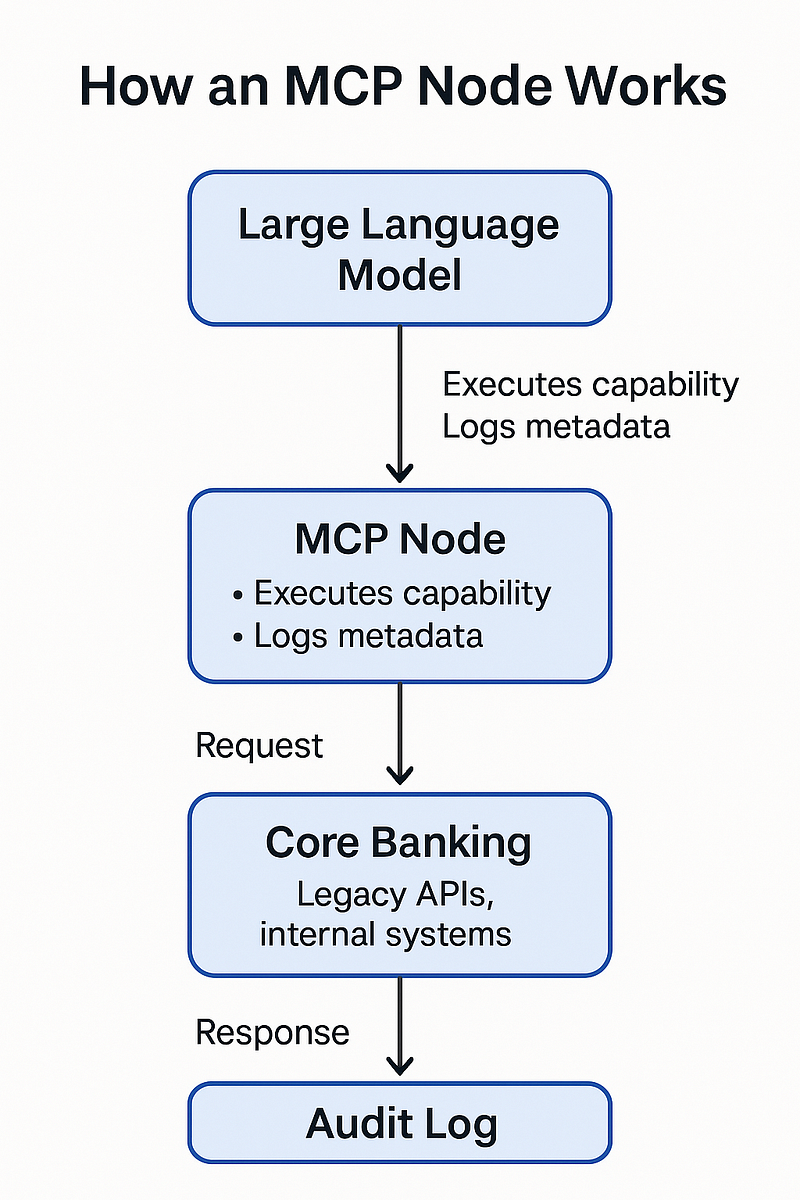
3 · Architecture Overview — The MCP Node in Action
When an AI agent interacts with banking systems via MCP, the flow looks like this:

Each step adds intelligence and control.
Unlike traditional API gateways, MCP doesn’t just pass through calls — it interprets them contextually.
Every invocation carries governance metadata with it, baked into the protocol, not bolted on after.
4 · Step-by-Step: Building a Simple MCP Node for Banking
Let’s design a small but realistic example:
a node that fetches account summaries for a customer.
This one capability underpins dozens of copilots — from customer service to compliance dashboards.
🧩 Step 1 — Define the Capability
Name: getAccountSummary
Purpose: Retrieve
- account_balance
- last_transaction_date
- currency
Access: Authorized roles only (e.g., customer-service-read).
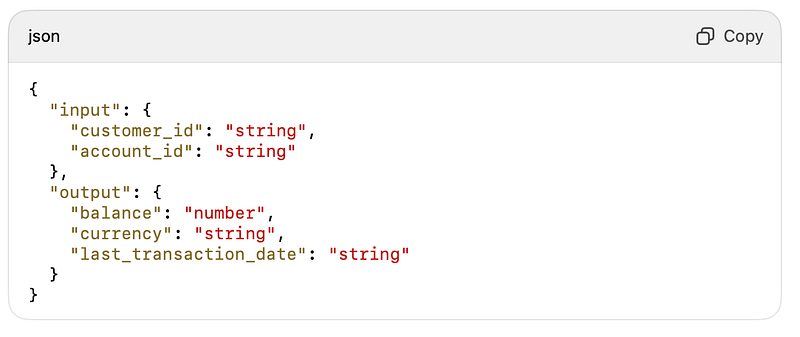
🧩 Step 2 — Define the Input and Output Schema
In MCP, every node uses a structured schema (typically JSON or YAML).
Example schema:
🧩 Step 3 — Add Policy Metadata
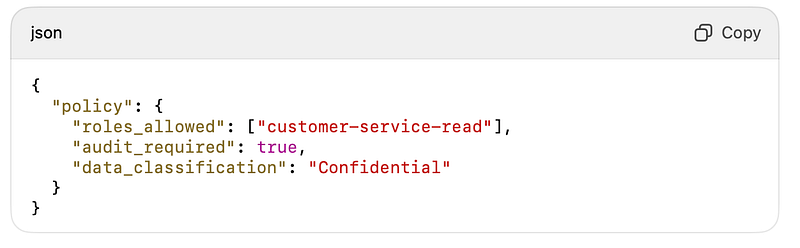
This ensures every call enforces least-privilege access and audit compliance.
🧩 Step 4 — Implement the Node Logic
The logic layer bridges legacy APIs to MCP.
Example (Python-style pseudocode):

🧩 Step 5 — Register the Node in the MCP Registry
Each node becomes discoverable through a registry service — the catalog models consult to learn available capabilities.

🧩 Step 6 — Model Invocation
Once registered, an AI copilot can invoke it through MCP syntax:

The model doesn’t “hack” through APIs — it negotiates access through the protocol.
5 · Beyond Basics — Context Linking and Composition
Single nodes are useful; composed nodes are transformational.
Imagine a credit-risk agent performing this sequence:
- Call getAccountSummary
- Call getLoanExposure
- Call validateCreditPolicy
Each is a separate MCP Node, but together they form a context chain — a declarative, auditable workflow of governed intelligence.
Because every node embeds its schema and policy, the entire chain remains traceable end-to-end.
That’s how banks can safely build AI agents that perform complex tasks like underwriting, fraud detection, or compliance review — without breaching governance.
6 · Observability and Auditability — MCP’s Silent Strength
In traditional API or RAG setups, tracking what a model accessed is messy.
With MCP, every call automatically generates structured telemetry:
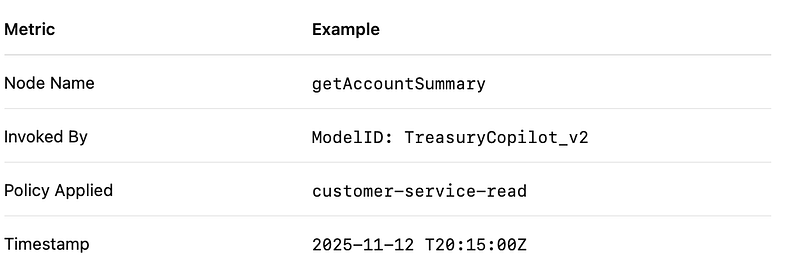
These logs feed directly into observability stacks (ELK, Datadog, AppDynamics, Splunk), giving both performance visibility and compliance traceability.
Model governance evolves from after-action audits to real-time accountability.
7 · Blueprint for Banks — From Node to Ecosystem
Building one MCP Node is a start.
Building a network of them is transformation.
Each department can expose its capabilities as nodes:
- Treasury → getFXRate()
- Risk → validateCreditPolicy()
- Compliance → getPolicyClause()
- CRM → getCustomerProfile()
Together, they form a Context Fabric — a governed layer through which AI systems, agents, and humans collaborate safely.
Soon, these fabrics will integrate with LangGraph / LangChain Agents, ModelOps pipelines, and enterprise observability stacks — turning MCP into the control plane for AI interactions across the bank.
8 · Accelerating with ContextForge MCP Gateway
If you don’t want to hand-build every node from scratch, platforms like ContextForge MCP Gateway already streamline this process.
They provide node templates, schema validators, and registry management tools — allowing teams to wrap existing APIs into MCP-compliant nodes within hours.
For banks, this means faster experimentation and a shorter path from concept to governed capability.
⚙️ Key Takeaways
- MCP Nodes are the building blocks of context-aware AI — standard, secure, and self-describing.
- They replace hard-coded API calls with auditable, governed interactions.
- Each node defines what can be accessed, by whom, and under what policy.
- Building multiple nodes creates a Context Fabric that powers copilots, agents, and ModelOps.
- MCP turns AI access from ad-hoc requests into a protocolized enterprise dialogue.
🔜 Next in the Series
👉 “Applying MCP in Banking: Risk, Compliance, and Customer Journeys.”We’ll move from the single-node design to enterprise-scale architecture — mapping how MCP powers credit scoring, fraud detection, and customer-360 copilots, complete with system diagrams and context-flow examples.