
From enterprise context fabrics to federated AI networks — how MCP will reshape collaboration, regulation, and intelligence in banking
From enterprise context fabrics to federated AI networks — how MCP will reshape collaboration, regulation, and intelligence in banking — Article 6
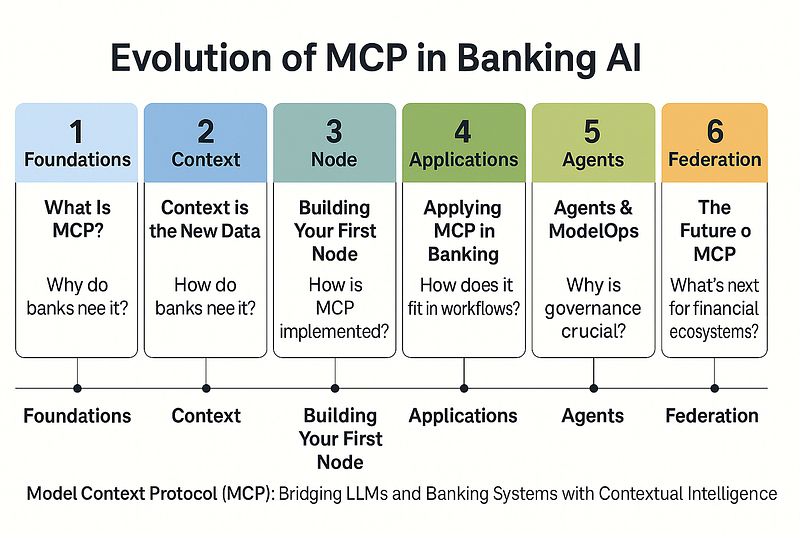
1 · A Decade That Belongs to Context
The past ten years were about digitizing data.
The next ten will be about contextualizing intelligence.
Banks have modernized infrastructure, APIs, and analytics — yet each institution remains an island of insight.
MCP changes that equation: it defines a shared grammar for intelligent systems, allowing models, tools, and humans to operate within a common, governed fabric.
Just as HTTP standardized information exchange, MCP will standardize context exchange — transforming not just how AI functions inside a bank, but how intelligence flows across the financial ecosystem.
2 · From Intra-Bank Context to Inter-Bank Collaboration
Today, every bank builds its own AI stack:
isolated copilots, internal LLMs, and proprietary connectors.
Tomorrow, those stacks will connect — not through data replication, but through federated context networks.
Federated MCP enables:
- Cross-bank interoperability: Securely sharing context (e.g., credit risk benchmarks, sanctions lists) without exposing raw data.
- Regulatory transparency: Regulators can query governed context streams instead of sifting through unstructured reports.
- Ecosystem orchestration: Fintechs and vendors register compliant MCP nodes discoverable via standard registries.
Each participant retains ownership of data; only auditable context envelopes move across boundaries.
3 · The Federation Model — How It Works
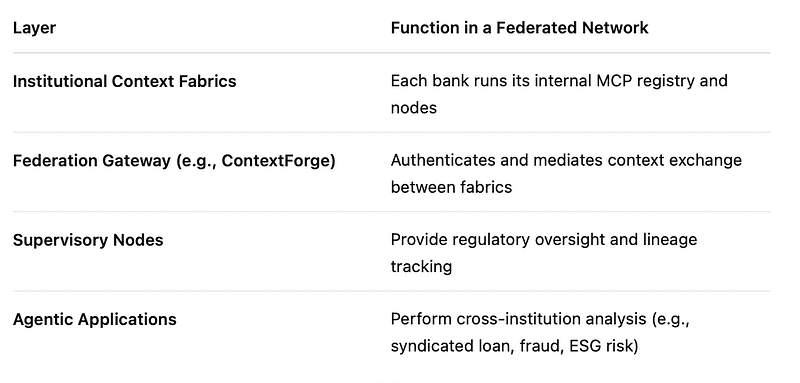
Every node interaction remains cryptographically signed, timestamped, and policy-bound.
Compliance isn’t an add-on — it’s built into the protocol.
4 · ContextForge MCP Gateway — The Bridge Layer
As these fabrics interconnect, ContextForge MCP Gateway is emerging as the enabling layer for real deployments.
It provides:
- Federated Registry APIs: Allow institutions to publish discoverable, policy-tagged context nodes.
- Secure Mediation: Handles authentication, encryption, and audit trail consolidation between banks.
- Telemetry Exchange: Normalizes observability data for ModelOps dashboards across entities.
- Code-Execution Nodes: Sandbox regulatory computations (e.g., capital ratio checks) across jurisdictions.
For early adopters, ContextForge is to MCP what Nginx was to HTTP — the operational gateway that turns a standard into a system.
5 · Regulatory Evolution — From Reporting to Real-Time Oversight
Regulators today rely on post-hoc reporting and sampling audits.
With MCP, they gain real-time contextual observability.
Supervisory authorities could:
- Subscribe to anonymized context streams from banks’ MCP fabrics.
- Verify credit or liquidity decisions algorithmically.
- Trace each model’s reasoning trail back to its data policy lineage.
This shifts compliance from retrospective enforcement to continuous assurance — a new paradigm of “always-on supervision.”
6 · From ModelOps to PolicyOps
As MCP networks mature, governance itself becomes programmable.
ModelOps governs models.
PolicyOps will govern the policies those models follow.
Banks will publish regulatory policies as machine-readable MCP nodes — e.g., validateBaselExposure() or checkAMLThreshold() — enabling both internal and regulator-run agents to verify compliance dynamically.
ContextForge and similar gateways will host shared policy registries, versioned and auditable, forming the digital commons of financial governance.
7 · Intelligent Interoperability — AI That Respects Boundaries
Future AI systems won’t break walls; they’ll negotiate them.
MCP’s design — declarative, typed, and policy-aware — ensures that cross-entity intelligence happens with traceability, not trust-fall.
Scenario: Federated Fraud Detection
- Each bank exposes anonymized getTransactionPattern() nodes.
- A joint agent (via ContextForge) aggregates anomaly signals without accessing raw transactions.
- Regulators receive verified alerts, complete with policy lineage.
Result: shared intelligence without shared data — a privacy-preserving revolution in compliance collaboration.
8 · Strategic Implications for Financial Leaders
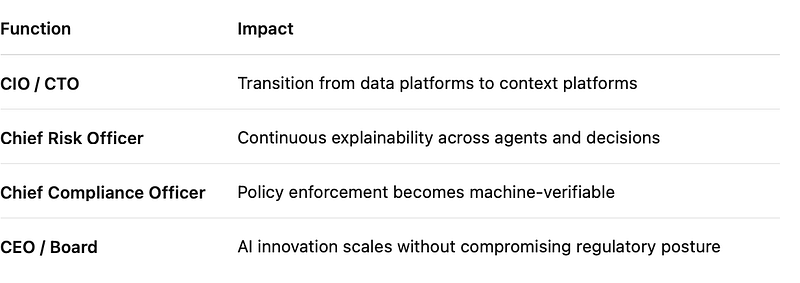
The lesson is clear: context is the new control plane.
9 · A Vision for future — The Contextual Internet of Finance
Picture future:
- A trade finance AI negotiates credit terms across three continents using federated MCP nodes.
- A central bank supervises liquidity positions via real-time policy nodes.
- Every transaction carries its contextual DNA — who approved it, under which policy, and when.
That’s the Contextual Internet of Finance — not powered by static data lakes, but by living context fabrics.
🔚 Closing Thought
The web connected pages.
APIs connected applications.
MCP connects intelligence.
With gateways like ContextForge MCP, banks and regulators can finally build AI systems that are secure by design, explainable by default, and collaborative by protocol.
This is the next leap — from data sharing to context federation — where financial ecosystems think, reason, and comply together.